
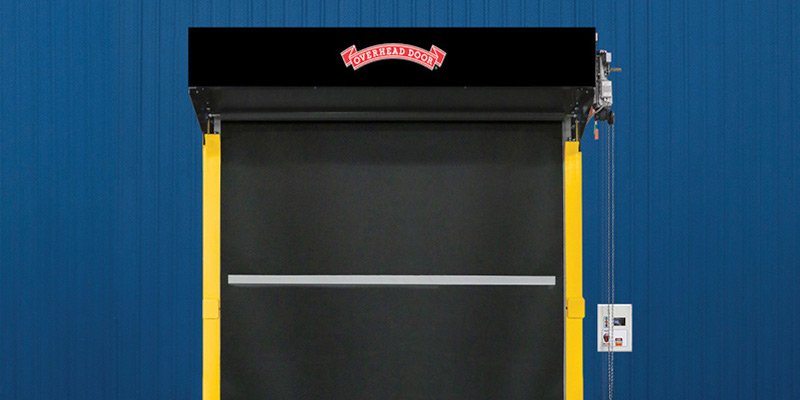
Deciding on high-speed vs. sectional commercial doors depends on how your commercial opening is used, how often vehicles pass through, and what your facility needs from the door.
High-speed commercial doors are worth considering for frequent traffic where opening and closing time matters. Sectional overhead doors may be more practical for openings with fewer cycles, specific exterior closure requirements, or tighter equipment budgets. The best option depends on the exact models, installation conditions, and operating needs.
Overhead Door Company of Brunswick helps businesses in Brunswick, Georgia, evaluate commercial door options. Here’s what to compare before selecting a system.
High-Speed vs. Sectional Commercial Doors: Key Differences
Both door types can serve commercial and industrial properties, but their designs and operating characteristics differ.
| Feature | High-Speed Door | Sectional Overhead Door |
|---|---|---|
| Primary consideration | Frequent, time-sensitive access | General commercial access and closure |
| Operating speed | Designed for faster movement, depending on model | Varies by door and operator |
| Construction | Flexible curtain or rigid system | Hinged panels traveling along tracks |
| Common applications | High-traffic work zones and industrial openings | Warehouses, service bays, and commercial buildings |
| Space requirements | Model-specific guides, drive, and controls | Overhead tracks and available headroom |
| Maintenance | Depends on design and operating cycles | Depends on hardware, operator, and usage |
| Installation cost | Requires a project-specific quote | Requires a project-specific quote |
These are general comparisons, not guaranteed specifications. Always compare the manufacturer and model included in each proposal.
Explore Brunswick’s commercial overhead door services and high-speed door page for more information about the available options.
1. How Often Does Your Commercial Door Open?
Start by understanding the traffic through the opening. Consider how many opening and closing cycles occur each day, particularly during the busiest hours. A warehouse entrance used repeatedly by forklifts may have different requirements from a vehicle bay that opens only a few times per shift.
Ask:
- How many vehicles or workers use the opening?
- How many times does the door cycle during peak hours?
- How long does it remain open?
- Does door operation interrupt deliveries or production?
- Are staff leaving the door open to avoid repeated cycles?
Confirm how each manufacturer defines and rates operating cycles. A busy facility does not automatically need a high-speed door at every opening. The traffic pattern at that specific location determines the practical benefit.
2. When Is a High-Speed Commercial Door the Better Choice?
A high-speed door may be suitable when an opening handles repeated traffic and reducing open time is an important operational goal. Potential applications include high-traffic warehouse zones, production areas, and openings separating different working environments. However, the actual benefit depends on the selected model, traffic spacing, controls, and how long the door remains open between movements.
Before choosing a high-speed system, confirm:
- Published opening and closing speeds
- Manufacturer-rated duty
- Interior or exterior suitability
- Wind-exposure limitations
- Available safety and activation controls
- Maintenance requirements
Not every high-speed door uses the same construction. Some use flexible curtains, while others have rigid components. Ask the installer to explain why a particular model fits your opening instead of assuming the fastest available product is the best choice.
3. When Does a Sectional Overhead Door Make More Sense?
A commercial sectional door may be appropriate for vehicle bays, service facilities, storage buildings, and other openings where very fast operation is not essential. Sectional doors consist of connected panels that travel along tracks when opened. The selected door, operator, hardware, and installation must be appropriate for the expected workload.
A sectional system may be worth considering when:
- Opening cycles are relatively limited
- The facility needs a substantial exterior closure
- The building has suitable overhead clearance
- The required operating speed fits the workflow
- The proposed equipment meets the project’s other requirements
A lower initial quote should not be the only consideration. If employees regularly wait for the door or leave it open to avoid repeated operation, discuss whether the proposed system adequately supports the workload.
4. Compare Clearance and Building Requirements
Door selection involves more than measuring opening width and height. The installer should also review available headroom, side clearance, ceiling obstructions, and mounting conditions.
For sectional overhead doors, overhead tracks and the raised door need suitable space. For high-speed doors, clearance requirements depend on the curtain or rigid construction, guides, drive components, and controls. Other considerations may include lighting, sprinkler systems, ductwork, vehicle approach routes, and pedestrian traffic.
Do not purchase a commercial door based on opening dimensions alone. Have the installer verify the actual site and the manufacturer’s installation requirements.
If pedestrians and forklifts share the area, discuss traffic separation, visibility, and protective controls. Never bypass a safety device to improve traffic flow.
5. Evaluate Weather Protection, Security, and Operating Conditions
For exterior commercial openings in Brunswick, Georgia, discuss exposure to wind and rain. Ask for the documented performance ratings applicable to the exact model, door size, and proposed installation. A general product description does not establish compliance with local requirements.
For conditioned facilities, consider how long the opening remains exposed, the door seals, and the operating controls. A faster-closing door may help address some exposure concerns, but energy savings cannot be guaranteed from speed alone.
Security also needs separate consideration. A flexible high-speed traffic door and a sectional exterior closure may offer different security characteristics. Describe the access-control and security requirements before choosing either system.
6. Consider Installation Cost and Long-Term Maintenance
The installed cost of a commercial door depends on the opening and the complete scope of work. Factors may include:
- Door construction and dimensions
- Operator and control equipment
- Electrical work
- Safety devices
- Installation access and mounting conditions
- Removal of existing equipment
- Maintenance and replacement parts
Request itemized estimates covering the same scope. One proposal may include electrical connections, removal, and commissioning, while another may exclude them.
Also consider the cost of operational interruptions. A door that frequently breaks down or slows production may have consequences beyond the immediate repair expense.
Ask about recommended maintenance intervals, service availability, and manufacturer requirements. Overhead Door Company of Brunswick offers a commercial preventative maintenance program for commercial doors and operators.
Commercial Door Safety: When to Stop Operation
Do not use a commercial door that is crooked, unusually heavy, off-track, or has a damaged spring or cable.
Keep employees and equipment away from the opening until a qualified technician has inspected the system. Never adjust springs, cables, drums, or other tensioned components without appropriate professional training. Electrical and access-control work should also be handled by qualified personnel. A damaged door or malfunctioning protective device should not be bypassed simply to maintain operations.
Questions to Ask Before Choosing a Commercial Door
Before approving a high-speed or sectional door installation, ask each supplier:
- Which manufacturer and model are you recommending?
- What operating speed and cycle duty does the system support?
- Does the door fit our opening and available clearance?
- What protective devices and controls are included?
- Does the model suit our exterior exposure or interior conditions?
- What maintenance does the manufacturer recommend?
- What parts, installation work, and electrical services are included?
- What are the written warranty terms and exclusions?
A useful proposal should explain the tradeoffs, including circumstances where the alternative door type might be more appropriate.
Frequently Asked Questions
Is a High-Speed Door Always Better for a Busy Facility?
No. A high-speed door may be beneficial for frequently used openings, but not every opening in a busy facility requires fast operation. Compare traffic patterns, operating needs, and the specific door models before deciding.
Can a Sectional Door Handle Frequent Use?
Yes, depending on the selected door, operator, hardware, and manufacturer-rated duty. Provide the expected operating cycles and request documentation showing that the proposed complete system suits the workload.
Does a High-Speed Door Replace a Security Door?
Not necessarily. Security capabilities vary by construction and model. Some facilities may need a separate closure to meet their security requirements. Confirm the proposed system’s capabilities with the supplier.
How Much Does Commercial Door Installation Cost?
Costs depend on the opening dimensions, selected system, controls, electrical requirements, installation conditions, and project scope. Request an itemized quote for your specific facility rather than relying on a generic advertised price.
Can Employees Repair a Damaged Commercial Door?
Employees can report damage and keep the opening clear, but should not adjust tensioned hardware or electrical controls. If a door is crooked, off-track, unusually heavy, or has damaged springs or cables, stop using it until a qualified technician inspects it.
Will a High-Speed Door Reduce Energy Costs?
Potentially, depending on operating patterns, environmental conditions, controls, and the door’s specifications. Faster operation alone does not guarantee lower energy costs. Evaluate the complete installation and how the opening is used.
Find the Right Commercial Door for Your Brunswick Facility
Comparing high-speed vs. sectional commercial doors starts with understanding how your building operates. Consider traffic volume, opening dimensions, required performance, safety, maintenance, and the complete installation cost.
Overhead Door Company of Brunswick helps businesses evaluate commercial overhead doors and high-speed door systems in Brunswick, Georgia.
Call (912) 602-6937 or use the contact form to discuss your commercial opening. Share your approximate dimensions, expected daily traffic, and operational priorities so the team can review suitable options and explain what an estimate would include.