
It is 7:20 on a weekday morning. Your garage door rises two feet, tilts, and stops with one side lower than the other. You need the car, but you do not know whether you are facing one repair or the end of the whole door.
We are Overhead Door Company of Brunswick, a garage door company based in Brunswick, Georgia. The short answer is that an isolated, replaceable failure usually favors repair, while widespread section, hardware, or structural damage can make replacement the more sensible long-term choice.
Age alone does not settle it. The decision should come from the condition of the sections, track, counterbalance parts, opener, safety features, and attachment points.
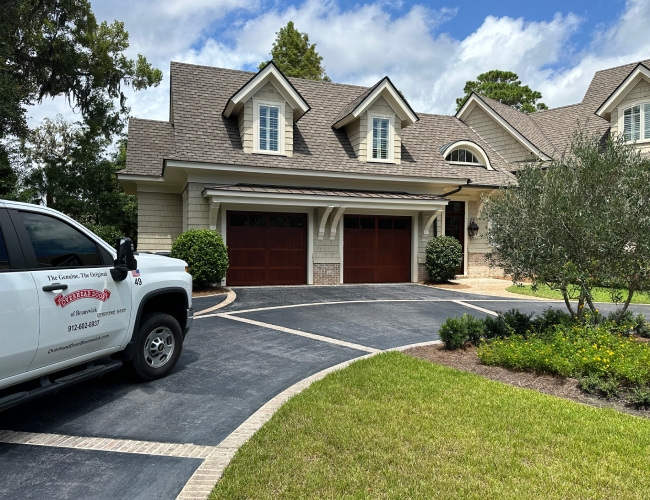
Image Specification 1: Hero photo, 1600 x 900. A real Brunswick-area residential garage with a technician inspecting one damaged lower section while the full door remains visible. Do not stage anyone touching a spring or cable. Alt text: “Technician evaluating whether a damaged garage door should be repaired or replaced.”
The Fast Decision Guide
One Damaged Component
One damaged hinge, roller, seal, or opener component may be serviceable. Inspect and price a targeted repair.
One Dented Section
One dented section may be replaceable if the rest of the system is sound and an exact match is available. Compare repair with replacement.
A Crooked, Off-Track, Dropping, or Heavy Door
These symptoms may indicate cable, spring, track, or balance failure. No. Stop using the door. Request service.
Damage Across Multiple Sections
Cracks, fatigue, or separation across several sections may mean lost door integrity. Evaluate replacement.
Repeated Failures in Several Systems
Individual repairs may be treating symptoms one at a time. Compare a bundled repair with replacement.
Opener Failure With a Sound Door
A sound, balanced door may not need replacement when its opener fails. Diagnose the opener separately.
Limited Surface Rust
Cosmetic surface rust may require only finish maintenance or localized repair. Inspect the metal and attachment points.
Corrosion in Moving or Load-Carrying Parts
Corrosion affecting cables, brackets, fasteners, track, or section edges may compromise critical parts. Stop operation and request professional evaluation.
DASMA’s residential checklist treats springs, hardware, section condition, movement, roller tracking, balance, and entrapment protection as separate checks. One failure does not condemn the door, but several can change the economics and safety picture.
Start With Safety, Not the Price
A crooked or suddenly heavy door is not a test project. If a spring is broken, a cable is loose, a bottom bracket is damaged, or the door hangs unevenly, No. Stop using the door. Do not pull the release or muscle it closed.
Springs, cables, brackets, and mounting surfaces can hold or transfer stored energy. DASMA says consumers should not remove, repair, or adjust them; a trained door systems technician should do the work. Its code guidance says to inspect spring-tensioned components visually without touching them.
Keep people, pets, and vehicles out of the opening. If the door is open and looks unstable, do not stand or walk beneath it.
A Six-Part Repair-or-Replace Framework
1. Define the Failure’s Scope
First ask whether the problem is confined to one component. A worn roller, damaged hinge, failed seal, loose non-tensioned fastener, remote, or operator accessory can often be addressed without replacing a sound door.
Look for linked symptoms. Noise with a tilted bottom edge, slack cable, and a roller leaving the track may be one counterbalance or alignment failure affecting the system. Stop operation.
The distinction is isolated versus distributed damage. Repair is strongest when a clear, replaceable failure does not leave worn surrounding parts carrying a renewed load.
2. Judge the Door Sections, Not Just the Dent
A shallow dent differs from a folded section, torn stile, cracked panel, material separation, or damage at a hinge or operator bracket. DASMA’s checklist asks whether sections are free of fatigue, cracking, and separation.
One damaged section may be repairable when the manufacturer supplies a compatible model, size, construction, profile, and finish. A near-match can create fit, appearance, and hardware-alignment problems.
Replacement becomes more reasonable when damage crosses several sections or reaches hinge, strut, roller, or opener-arm attachments. These are not merely cosmetic; they help the door move as an assembly.
3. Evaluate Track, Balance, and Structural Attachment
During DASMA’s controlled inspection, a door should travel freely, keep its rollers in the track, remain fully open, and stay partially open. A door that races down, feels heavy, binds, or will not stay needs a professional balance and hardware check.
The opening also matters because track brackets, spring supports, and jamb attachments transfer force into the building. DASMA says door-to-framing connections are as important as door design and recommends engineering advice when wind forces and building-envelope integrity are at issue.
A loose bracket does not always require a new door. The quote should say whether work is limited to hardware or must also correct damaged jambs, header material, track, and door components.
4. Separate the Opener From the Door
The opener moves the door; it is not the counterbalance system. A failed circuit board, motor, rail, remote, or photoelectric sensor can often be serviced while the door remains.
A stronger opener does not fix a heavy, binding, or unbalanced door. DASMA says safe operation requires a balanced door, effective operator, and functioning entrapment protection.
The U.S. Consumer Product Safety Commission says automatic residential openers made on or after January 1, 1993, must have an automatic reversing system such as photoelectric eyes or another approved protection. An older opener lacking that protection may need replacement even when the door stays.
5. Confirm Parts and Product Compatibility
A replacement part must belong in the system. Before a section or major hardware repair, confirm the manufacturer, model or series, dimensions, thickness, track setup, spring design, and finish.
A single-section repair may not be practical when the correct panel is unavailable or adjacent hardware needs work.
If most sections, the track, counterbalance system, and major attachments need work, request a replacement comparison. Avoid paying for a partial rebuild that leaves little worth keeping.
6. Compare Today’s Fix With the Next Likely Fix
A fair comparison includes current work, compatible parts, disposal, and the condition of what remains. It should show whether repair resolves the cause or only a symptom.
Repair usually wins when one serviceable item failed and the rest checks out. Replacement gains ground with several damaged components, unavailable sections, extensive structural corrections, or repeated failures.
Avoid universal percentage rules. Without a verified local quote for the exact door and opening, “replace when repair reaches half the cost” can mislead. Compare written scopes.
Image Specification 2: Decision graphic, 1200 x 1200. Four labeled real close-ups: isolated roller wear, cracked section at hinge attachment, slack cable with a red “Do Not Touch” icon, and widespread corrosion at a bracket. Alt text: “Examples of repairable and replacement-level garage door damage.”
When Repair Usually Makes Sense
A targeted garage door repair often makes sense when the problem is limited and the rest of the system remains sound.
The Damage Is Isolated
Repair is strongest when one replaceable component has failed, the sections remain straight and connected without significant cracking or separation, and the track and mounting points are sound.
Compatible Parts Are Available
A matching panel or manufacturer-approved part must be available, and the repair should restore balanced, smooth travel without rebuilding most of the system.
The Opener Can Be Handled Separately
The opener should have compliant, working entrapment protection or be addressed separately. Its failure alone does not require replacing a sound door.
Repair also makes sense when you like the existing door and its construction still serves the opening. A new product is not automatically better value than a sound door with one worn part.
After the immediate fix, a residential preventive maintenance plan can help document changes in balance, hardware, and safety-device operation. Maintenance cannot reverse structural damage, but it can make developing problems easier to see.
When Replacement Usually Makes Sense
Full replacement deserves consideration when damage is widespread, parts cannot be matched, or restoration requires work across several systems.
The Door Has Widespread Structural Damage
Replacement becomes more reasonable when multiple sections show folding, cracking, fatigue, separation, or damage at hardware attachments. It may also fit when opening, track, or framing damage prevents correct fit and travel.
Corrosion or Parts Availability Limits a Safe Repair
Major corrosion across several moving or load-carrying parts can make repair insufficient, as can a discontinued section that cannot be matched safely.
Several Major Systems Need Work
Replacement may be clearer when several expensive subsystems need work or an impact caused damage that a verified section-and-hardware repair cannot restore.
The Project Requires a Different Configuration
A different door configuration can justify replacement if its opening and attachment design are also evaluated.
Replacement should still solve a defined problem. If only the opener is bad, compare garage door opener service before replacing a good door. If replacement is justified, review residential garage door options only after the opening, damage, and required scope are clear.
How Brunswick’s Coastal Exposure Changes the Inspection
Coastal exposure is not an automatic replacement verdict. Distance from the water, wind exposure, shelter, finish condition, drainage, and maintenance all change what happens at a particular home. The useful question is whether the environment has produced observable damage.
For a garage door near the coast, the useful evidence is what the inspection finds: rust or material loss at section edges, hinges, fasteners, brackets, tracks, cables, spring assemblies, and attachment points. The word “coastal” on an estimate is not a diagnosis.
Surface staining on an otherwise intact finish may call for cleaning and product-specific finish care. Rust scaling, pitting, frayed cable strands, weakened fasteners, or corrosion where hardware attaches changes the conversation because those parts guide, connect, or carry the door.
Wood doors need a different check. DASMA says all six sides of exposed wood or wood-composite sections should be finished to limit moisture penetration and warns against leaving unfinished material exposed to the elements. Localized finish failure may be maintainable; soft, split, or deteriorated wood around hardware attachment points may not be.
Image Specification 3: Detail photo, 1200 x 800. Real close-up of a coastal-area garage door showing the difference between light surface staining and pitting at a hinge or fastener. Include a ruler for scale and no unsafe handling. Alt text: “Surface rust compared with deeper corrosion at garage door hardware.”
What Determines the Quote?
No verified local price range can cover every repair-versus-replacement decision, so this article does not invent one. Ask for an itemized quote that states what remains, what is replaced, and why.
For repair, price drivers include the failed component, number of affected parts, door size and weight, spring or track configuration, panel availability, finish matching, access, and whether structural attachment work is needed. For replacement, the main factors include opening size, door construction and finish, windows or other selected options, track and counterbalance configuration, opener compatibility, required wind design and attachment work, removal, and disposal.
Compare equal scopes. A repair that excludes a damaged track or failing attachment point is not comparable to a complete replacement quote. Nor is a replacement loaded with options you do not need.
Questions to Ask Before You Decide
Which Exact Parts Failed, and What Evidence Shows That?
Connect each recommendation to an observed condition.
Are the Remaining Sections and Attachment Points Structurally Sound?
Ask what can safely remain and why.
Can the Door Be Restored to Balanced, Smooth Travel?
Confirm that the proposed work restores balanced, smooth travel.
Is the Replacement Section or Part Compatible and Available?
Confirm manufacturer compatibility and actual availability.
Does the Quote Correct the Cause as Well as the Symptom?
Ask whether the work addresses the underlying failure.
What Work Is Excluded From Each Option?
Use clear exclusions to compare equal scopes.
Why Is a Targeted Repair Insufficient?
Ask why focused repair cannot safely and effectively restore the system.
A useful evaluation should make the answer understandable without asking you to diagnose tensioned hardware yourself.
Frequently Asked Questions
Is It Cheaper to Repair or Replace a Garage Door?
A localized repair is generally the smaller scope, but the honest answer depends on the failed parts and what can safely remain. Compare itemized local quotes rather than a national percentage rule or an unverified online average.
Can One Damaged Garage Door Panel Be Replaced?
Sometimes. The section must be available in the correct model, size, construction, profile, and hardware configuration, and the surrounding sections must still be sound. If an exact compatible section is unavailable or several sections are damaged, replacement may make more sense.
Does a Broken Spring Mean I Need a New Garage Door?
Not automatically. A broken spring is often a component failure, but it requires professional service. No. Stop using the door. The technician should also check the door’s weight, balance, cables, bearings, and other hardware before recommending the scope.
Should I Replace the Door If the Opener Stops Working?
Usually not without diagnosing the two systems separately. A sound, balanced door may only need opener repair or replacement. A new opener, however, must not be used to mask a binding or unbalanced door.
Is a Rusty Garage Door Unsafe?
Not every rust spot is a safety failure. Surface staining differs from pitting, scaling, frayed cable strands, or corrosion at brackets, tracks, fasteners, and section attachments. Do not touch or test corroded tensioned parts; request an inspection.
How Long Does a Garage Door Inspection Take?
Time varies with the door and damage. DASMA says its basic consumer inspection checklist can be completed in about 15 minutes, but diagnosis, measurements, parts identification, and quote preparation may take longer.
Can I Keep Using a Crooked Garage Door Until My Appointment?
No. Stop using the door. A crooked door can indicate a cable, spring, roller, track, or balance problem. Keep the opening clear and arrange professional service.
Get a Clear Repair-or-Replace Recommendation
If your door is damaged, noisy, crooked, stuck, or failing repeatedly, Overhead Door Company of Brunswick can evaluate the system and prepare the appropriate service scope. We serve Brunswick and priority areas across Brantley, Bulloch, Camden, Charlton, Chatham, Glynn, McIntosh, Pierce, Ware, and Wayne counties.
Call (912) 602-6937 or request an estimate online. You do not need to diagnose the spring, cable, opener, or panel before calling; describe what you saw, stop operating an unstable door, and let the inspection separate a focused repair from a justified replacement.